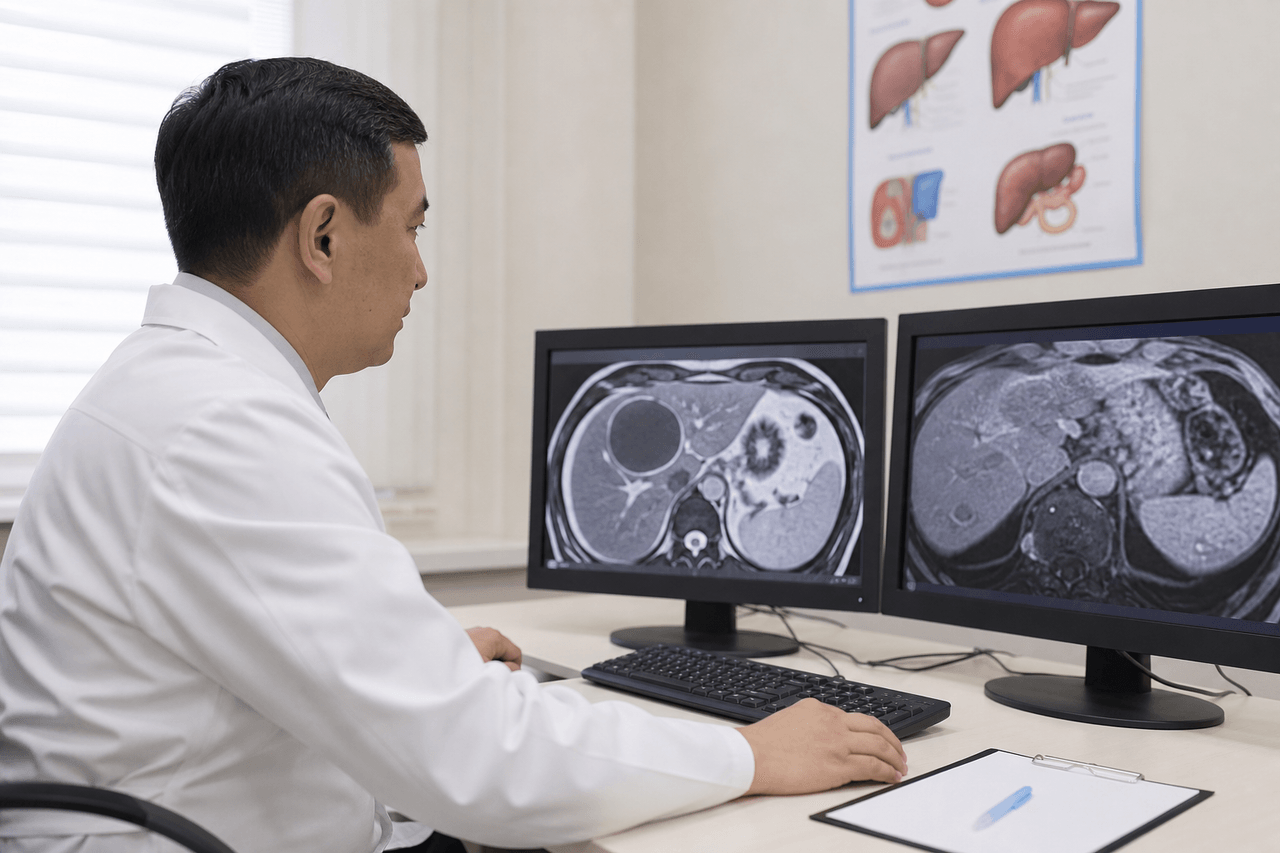
In Central Asia pediatric echinococcosis is seen regularly — contact with dogs, playing in soil, unwashed fruit and vegetables create infection risk. Yet diagnosis is often incidental: on routine ultrasound or workup for another reason.
A child's liver is relatively large; a cyst can grow for a long time without clear complaints. Children cannot always describe discomfort — parents notice fatigue, poor appetite, or "something wrong" but do not link it to a parasitic disease.
This article is not for self-diagnosis but to clarify when watchful waiting is reasonable and when ultrasound and specialist consultation are needed.
How pediatric echinococcosis differs from adult disease
In children a cyst is often found at an earlier stage (CE1–CE2) simply because the abdomen is still small — even a moderate lesion is more noticeable on ultrasound. Clinically the child may look almost healthy.
Location varies: liver is most common, but lungs, spleen, and rarely other organs are possible. Multiple cysts in children require special follow-up.
A child's immune system responds differently: serologic tests (ELISA) may be weakly positive or negative despite a cyst. When suspected, ultrasound and CT come first — not blood tests alone.
- Long asymptomatic course — months and years.
- Nonspecific complaints: weakness, abdominal pain without clear location.
- Cyst "grows with" the child — relative size matters more than absolute.
- More often found by chance than by typical symptoms.
- Serology is less informative in children than in adults.
- Higher risk from dogs and rural environment in endemic areas.
Atypical and "masking" symptoms
The classic picture is right upper quadrant pain, heaviness, sometimes allergic reactions to parasite breakdown products. In children this is less common. Parents more often note: the child tires quickly, eats poorly, complains of a "tummy ache" without pointing to a spot.
With a lung cyst there may be dry cough or exertional breathlessness — easily blamed on a cold or asthma. With a large liver cyst the abdomen may bulge on one side. Unexplained fever can relate to abscess or rupture — that needs urgent care.
Allergic rash, itching, or eosinophilia on blood count may be the only signal. If these recur with animal contact, abdominal ultrasound is a reasonable step.
Cyst growth and school age
During active growth the cyst enlarges too — on average 1–3 cm per year in active stages (CE1–CE3). That does not mean the disease will "definitely become dangerous," but ultrasound follow-up is mandatory.
School workload, sports, and village visits to relatives are not automatically forbidden with a stable small cyst — the doctor sets limits. Large cysts or complication risk may mean restricting contact sports until workup is complete.
Discuss not only size in centimeters but WHO stage (CE1–CE5) — that drives surgery, medication, or observation. More on stages in WHO cyst stages.
When to order ultrasound for a child
Screening ultrasound without indications is not always needed, but some situations justify it. In endemic Central Asian areas, with stray-dog contact and persistent nonspecific complaints, ultrasound is a sensible first step.
Repeat ultrasound is for known cysts: interval depends on stage and dynamics — usually every 3–6 months for active cysts, less often for inactive ones (CE4–CE5).
CT in children is used cautiously — only when ultrasound is unclear, complications are suspected, or before planned surgery. A pediatric specialist weighs radiation exposure.
- Persistent abdominal pain without a clear cause.
- Rural dog contact plus weakness or poor appetite.
- Incidental "cyst" on ultrasound for another reason — needs verification.
- Recurrent allergic rash and eosinophilia.
- Cough or breathlessness not improving after "cold" treatment.
- Known cyst — follow the doctor's monitoring schedule.
A checklist for parents
Before the visit gather information — it speeds diagnosis and helps avoid missing key facts.
Do not scare the child with "parasites" before talking to the doctor, but honestly describe risk factors: dogs at home, dacha trips, raw milk, unwashed greens. The physician needs this for epidemiologic history.
- When symptoms started and how they changed.
- Contact with dogs, cats, farm animals.
- Village or dacha trips, soil and well-water exposure.
- Previous ultrasound and blood tests — bring reports and discs.
- Vaccinations, allergies, chronic conditions.
- Questions for the doctor: surgery needed, school and gym allowed.
Pediatric consultation at Visus Medical
At Visus Medical we see children and adults with suspected echinococcosis and alveococcosis. We review ultrasound and CT, explain cyst stage to parents, and outline options — observation, medication, or surgical referral.
We speak in plain language: what the scan means, how urgent action is, and what follow-up schedule makes sense. If your child already has a "liver cyst" report — bring it with imaging to the visit.
We do not promise "magic" cure with pills in a week — we help choose evidence-based care suited to age, stage, and the child's safety.
Need an echinococcosis consult?
Message us on Telegram or WhatsApp — we’ll review your scans and suggest a plan.