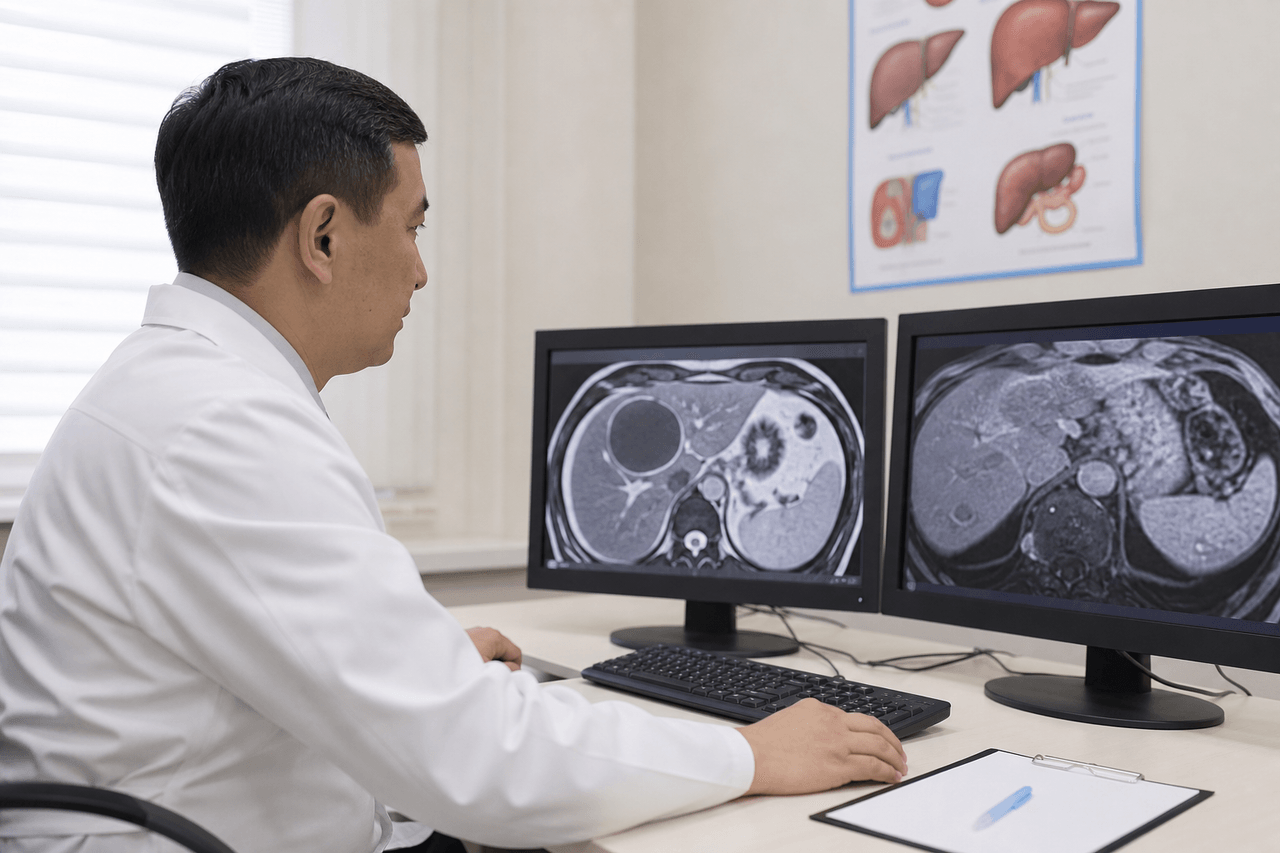
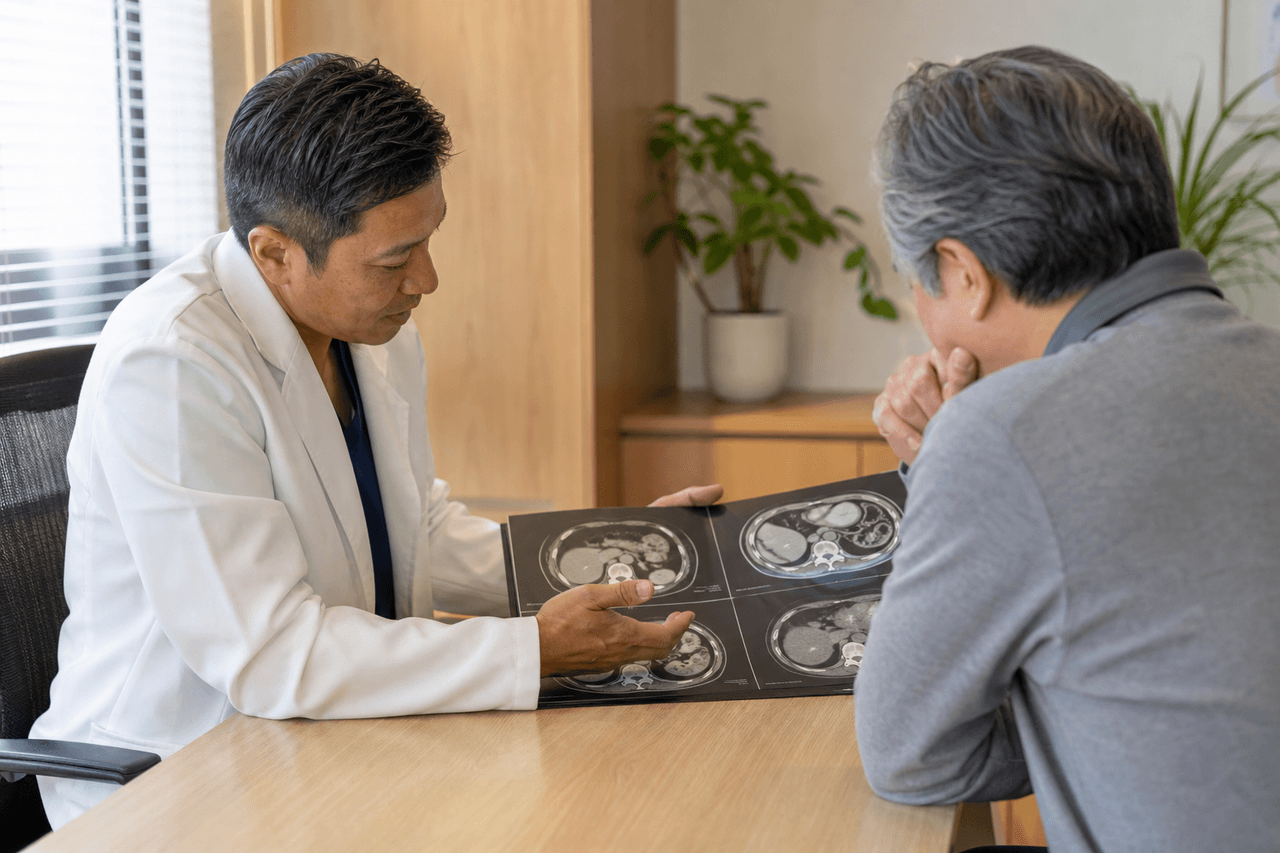
Liver echinococcosis is one of the most common concerns among parasitic diseases in Central Asia. The parasite can live in the body for 5–15 years until the cyst reaches a size that causes symptoms or is found by chance on ultrasound.
Important: having no symptoms does not mean "everything is fine." Many patients learn about a cyst only during a routine abdominal exam — at a pre-employment checkup, before surgery, or on ultrasound for another reason.
The liver is the most common site of echinococcosis: up to 70% of all cases. There may be one cyst or several, in the right or left lobe, sometimes reaching considerable size without causing acute pain. That is why knowing typical signs and regular screening in endemic regions matters.
Early signs — often vague
In the early stage, symptoms are nonspecific and easily blamed on gastritis, stress, overeating, or "liver fatigue." A patient may be treated for dyspepsia for years without suspecting a parasitic cause.
A small active cyst (WHO stages CE1–CE2) is often asymptomatic. The first complaints appear when the cyst grows, compresses nearby structures, or triggers an immune response.
- Heaviness or dull pain under the right ribs after meals, especially fatty food.
- Reduced appetite, mild nausea, early satiety with small portions.
- Weakness, lower work capacity, irritability without a clear cause.
- Periodic skin itching or hives — a reaction to parasite antigens.
- Mild fever that resolves on its own.
- Discomfort during physical activity or when bending to the right.
When symptoms become obvious
As the cyst grows, complaints intensify. A feeling of fullness, one-sided abdominal enlargement, and a "lump" under the ribs may appear. If the cyst compresses the bile ducts, mechanical jaundice develops: yellowing of the skin and sclerae, dark urine, pale stool.
With multiple cysts or a large solitary focus, abdominal volume may increase and visible asymmetry may appear. Some patients notice pulsation or "movement" in the liver area — related to pressure on the diaphragm and nearby organs.
A dangerous scenario is rupture or infection of the cyst: acute pain in the right upper abdomen, fever of 38–39 °C, chills, and a severe allergic reaction (hives, swelling, sometimes anaphylactic features). In such cases urgent medical care is needed — call emergency services or go to the ER.
- Marked pain in the right upper abdomen radiating to the shoulder or back.
- Jaundice — yellowing of the skin and whites of the eyes.
- Dark urine and pale, discolored stool.
- Fever when bacterial infection is added.
- Sudden weakness, dizziness, low blood pressure with rupture.
Symptoms depending on cyst location
Where the cyst sits in the liver affects the type of complaints. A cyst in the right lobe more often causes pain under the right ribs. In the left lobe, pain may be felt in the epigastrium or left upper abdomen, or be less pronounced.
Peripheral cysts (at the liver edge, against the peritoneum) can irritate the peritoneum and cause pain with movement. Cysts compressing the portal vein may cause leg swelling and abdominal vein dilation. Bile duct compression mainly presents as jaundice.
- Right lobe — classic right-sided pain, heaviness after meals.
- Left lobe — discomfort in the upper abdomen, less often left subcostal pain.
- Peripheral location — pain when walking, coughing, bending.
- Bile duct compression — jaundice, itchy skin, pale stool.
- Large size — abdominal enlargement, pressure on the diaphragm, shortness of breath.
What echinococcosis can resemble
Liver echinococcosis symptoms are easily confused with other conditions. Right upper abdominal pain occurs in gallstone disease, gastritis, and pancreatitis. Jaundice may appear in hepatitis, liver tumors, and bile duct obstruction.
That is why a symptom list alone is not enough for diagnosis. Abdominal ultrasound is decisive, plus CT or MRI when needed and serologic tests (ELISA for echinococcus antibodies). In Central Asian endemic regions, any liver cyst must be evaluated for echinococcosis.
When to see a doctor urgently
Not every sign of echinococcosis requires immediate hospitalization, but some situations should not be delayed. With acute symptoms — severe pain, high fever, marked jaundice — emergency care is needed.
With chronic but recurring complaints (right-sided pain, heaviness, poor appetite), a planned workup is enough: liver ultrasound and specialist consultation. In Uzbekistan, Kazakhstan, Kyrgyzstan, and Tajikistan echinococcosis remains relevant — routine ultrasound every 1–2 years is especially recommended for rural residents and dog owners.
- Acute severe abdominal pain not relieved at rest.
- Fever above 38 °C with chills and right upper abdominal pain.
- Rapidly worsening jaundice, dark urine, pale stool.
- Hives, lip or tongue swelling after side pain.
- Sudden deterioration, dizziness, fainting.
- Chronic right upper abdominal pain for more than 2–3 weeks — schedule an exam.
What to do if you suspect it
With recurring pain on the right side — especially if you live in an endemic region — have an abdominal ultrasound and discuss echinococcus serology with your doctor. Bring previous imaging and reports — follow-up matters for assessing cyst growth.
At Visus Medical we start with precise diagnostics: the cyst type by WHO classification (CE1–CE5) determines whether conservative treatment is possible or another approach is needed. We assess size, number of foci, relation to vessels and bile ducts, then build a clear plan — what to do now and how to monitor results.
If ultrasound already shows a cyst but "echinococcosis" is not yet confirmed — do not panic and do not delay further workup. Early diagnosis often opens a path to treatment without surgery.
Need an echinococcosis consult?
Message us on Telegram or WhatsApp — we’ll review your scans and suggest a plan.